
English Proverbs
전체기사 보기
-

“Actions Speak Louder Than Words”
“Actions Speak Louder Than Words”(Also known unofficially as: “The Show-Don’t-Tell Principle of Life”) Origin and Historical EchoesWith roots as far back as the 1600s, this proverb likely came from sermons or speeches emphasizing morality and credibility. Even Confucius wrote: “A superior man is modest in his speech, but exceeds in his actions.” In short: talk is cheap. Do something. Meaning and InterpretationThis proverb reminds us that intentions mean little without follow-through. What you do—not what you say—defines your values, your integrity, and your impact. It’s a call to live your bel
-

“Rome Wasn’t Built in a Day”
“Rome Wasn’t Built in a Day”Origin and Historical EchoesA medieval French proverb first popularized this idea, later translated into English in the 1500s. It captures one of life’s hard truths: Great things take time. Ancient Rome itself is the perfect metaphor—a sprawling city of innovation and beauty that rose over centuries, not sprints. Meaning and InterpretationThis proverb is a calm whisper amid our turbo-speed culture. It teaches patience, persistence, and the virtue of progress over perfection. Whether it’s building a city, a skill, or a self—it takes time. Applications in Education1.
-

“You Can’t Judge a Book by Its Cover”
“You Can’t Judge a Book by Its Cover”Origin and Historical EchoesThis proverb dates back to the mid-19th century, first appearing in the 1860s in George Eliot’s novel The Mill on the Floss. The metaphor is simple: appearances are deceiving. But the sentiment? Ancient. From Aesop’s fables to Confucian philosophy, wise folks everywhere warned against judging quickly. The outside rarely reveals the whole truth. Meaning and InterpretationThis phrase cautions against forming opinions based on looks, labels, or first impressions. That flashy book might be fluff. That plain one? A masterpiece. It rem
-

“You Can’t Judge a Book by Its Cover”
“You Can’t Judge a Book by Its Cover”Origin and Historical EchoesThis proverb dates back to the mid-19th century, first appearing in the 1860s in George Eliot’s novel The Mill on the Floss. The metaphor is simple: appearances are deceiving. But the sentiment? Ancient. From Aesop’s fables to Confucian philosophy, wise folks everywhere warned against judging quickly. The outside rarely reveals the whole truth. Meaning and InterpretationThis phrase cautions against forming opinions based on looks, labels, or first impressions. That flashy book might be fluff. That plain one? A masterpiece. It rem
- 관리자 기자
- 2025-07-09 07:37
-

“The Early Bird Catches the Worm”
“The Early Bird Catches the Worm”(Also known unofficially as: “Team Sunrise’s Motto”) Origin and Historical EchoesThis cheerful nugget of advice first chirped its way into English in the 1600s and has stuck around like a morning rooster ever since. While no one knows the exact first tweet (pun intended), the phrase likely hatched from farmers’ wisdom and early-riser ethics common across agrarian societies. The message? Those who act first, win first. Even Roman wisdom reflects similar sentiment—consider “Audentes fortuna iuvat” (Fortune favors the bold). But the early bird doesn’t just get luc
- 관리자 기자
- 2025-07-09 07:33
-
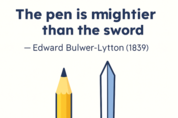
The Pen Is Mightier Than the Sword
The Pen Is Mightier Than the Sword"The pen is mightier than the sword." — Edward Bulwer-Lytton (1839) ️ Origin and Historical BackgroundThis famous proverb was coined by Edward Bulwer-Lytton, an English author and politician, in his 1839 play Richelieu; Or the Conspiracy. In the play, Cardinal Richelieu, a clergyman and statesman, utters the line: "Beneath the rule of men entirely great,The pen is mightier than the sword." The expression quickly gained popularity, emphasizing the power of communication, writing, and ideas over violence and physical force. But the idea predates Bulwer-Lytton. E
- 관리자 기자
- 2025-06-11 15:45
-

"Don’t Put Off Until Tomorrow What You Can Do Today"
"Don’t Put Off Until Tomorrow What You Can Do Today"(Also known unofficially as: “Procrastination’s Worst Enemy”) ️ Origin and Historical EchoesThis proverb is often attributed to Benjamin Franklin, that marvelously multitasking Founding Father who, when not inventing bifocals or taming lightning, dispensed practical wisdom in Poor Richard’s Almanack. However, its sentiment predates Franklin, echoing back to Latin maxims like “Carpe diem” (Seize the day) and even to Hesiod, who cautioned against idle delay in ancient Greek literature. It’s a timeless commandment in the temple of productivity—a
- 관리자 기자
- 2025-06-11 15:38
-

A Little Knowledge Is a Dangerous Thing
A Little Knowledge Is a Dangerous ThingOrigin and HistoryThis proverb originates from the English poet Alexander Pope, who wrote in his 1709 Essay on Criticism: “A little learning is a dang’rous thing;Drink deep, or taste not the Pierian spring.” The “Pierian spring” symbolizes the source of knowledge in Greek mythology. Pope’s warning was that superficial knowledge without deeper understanding can lead to overconfidence and mistakes. MeaningThe proverb highlights that: Knowing only part of a subject can lead to false confidence. Without full understanding, one may make poor decisions, as
- 관리자 기자
- 2025-06-11 15:10
-

Tell Me and I Forget. Teach Me and I Remember. Involve Me and I Learn.
Tell Me and I Forget. Teach Me and I Remember. Involve Me and I Learn.Origin and HistoryThis widely quoted proverb is often attributed to Benjamin Franklin, though its roots may go deeper, possibly influenced by Confucian philosophy or earlier oral traditions. The exact source is debated, but the core idea—that active involvement deepens understanding—has long been central to effective education methods across cultures. Confucius once said, "I hear and I forget. I see and I remember. I do and I understand."—a sentiment nearly identical in spirit. Whether East or West, the wisdom remains univer
- 관리자 기자
- 2025-06-11 14:50
-
 CEO Yoo Jeong-geol – The 'Last Puzzle' of Medical School Admission is Literacy: The Victory of Intellect Overcoming Skill
-
 "Peace Begins in Life"… IWPG Successfully Concludes 'Only Peace Conference' in Busan
-
 The Ministry of Health and Welfare plans to train an average of 668 doctors annually to work in essential public health services in local areas over the next five years, starting in 2027.


-
 Medical · Health
The Ministry of Health and Welfare plans to train an average of 668 doctors annually to work in essential public health services in local areas over the next five years, starting in 2027.
Medical · Health
The Ministry of Health and Welfare plans to train an average of 668 doctors annually to work in essential public health services in local areas over the next five years, starting in 2027.
-
 IT · Science
17 domestic humanoids gather at DDP, and Seoul City hosts the 'Seoul AI Festival'
IT · Science
17 domestic humanoids gather at DDP, and Seoul City hosts the 'Seoul AI Festival'
-
 Entertainment · Broadcasting
[SBS My Little Old Boy] Moon Chae-won, to Seo Jang-hoon, who has 4 trillion won(?), says, “Hey, just give me 1 trillion won~” cutely... What will Seo Jang-hoon say?
Entertainment · Broadcasting
[SBS My Little Old Boy] Moon Chae-won, to Seo Jang-hoon, who has 4 trillion won(?), says, “Hey, just give me 1 trillion won~” cutely... What will Seo Jang-hoon say?
-
 Education · Society
Jeju RISE: Sharing the Results of "Industry-Academic Cooperation"
Education · Society
Jeju RISE: Sharing the Results of "Industry-Academic Cooperation"
-
 Education · Society
Goseong County's Dinosaur Land Shopping Mall Wins Consumer-Friendly Brand Award at the 2026 Korea Consumer Awards for 9 Consecutive Years
Education · Society
Goseong County's Dinosaur Land Shopping Mall Wins Consumer-Friendly Brand Award at the 2026 Korea Consumer Awards for 9 Consecutive Years
-
 Politics · Economy
President Lee Jae-myung: "Price stabilization is urgent... Actively developing and implementing policies to ease the burden on people's livelihoods."
Politics · Economy
President Lee Jae-myung: "Price stabilization is urgent... Actively developing and implementing policies to ease the burden on people's livelihoods."
-
 Politics · Economy
President Lee Jae-myung awards the Samjeonggeom sword to a newly promoted brigadier general.
Politics · Economy
President Lee Jae-myung awards the Samjeonggeom sword to a newly promoted brigadier general.
-
 Entertainment · Broadcasting
Fair Play Menarini International Award, 29th Award Ceremony marked by waves of emotion
Entertainment · Broadcasting
Fair Play Menarini International Award, 29th Award Ceremony marked by waves of emotion
-
 Entertainment · Broadcasting
The Rose, the first Korean band to perform at Coachella, confirms Seoul concert on August 30 for “Once Upon a WRLD”
Entertainment · Broadcasting
The Rose, the first Korean band to perform at Coachella, confirms Seoul concert on August 30 for “Once Upon a WRLD”
-
 Culture · Events
Incheon Port Authority kicks off the 6th Incheon International Marine Forum in Songdo, Incheon, to look into the future of the global marine industry
Culture · Events
Incheon Port Authority kicks off the 6th Incheon International Marine Forum in Songdo, Incheon, to look into the future of the global marine industry


오피니언
-
CEO Yoo Jeong-geol – The 'Last Puzzle' of Medical School Admission is Literacy: The Victory of Intellect Overcoming Skill
[Intro] A strategist who reads the deficiencies of the times and writes the future of children Today, the field of education in South Korea stands before a massive wave of 'speed' and 'efficiency.' To achieve a single point, children drift between printed words, and amidst a maze of correct answers, they are forgetting how to ask themselves who they truly are. In this era of chaos, there is a figure who travels back and forth between Busan and Seoul, calling for the 'restoration of the essence of education.' CEO Yoo Jeong- geol. He is a strategist who examines children's "thinking muscles" bey
-
"Peace Begins in Life"… IWPG Successfully Concludes 'Only Peace Conference' in Busan
The International Women's Peace Group (IWPG) Global 4 countries held the '2026 Only Peace Conference' on the 21st at Room 104 of the Busan Eurasia Platform at Busan Station. The event was a great success, with over 100 local citizens and peace activists in attendance. ▲ Group commemorative photo The theme of this conference was 'Voices for Peace: How Women Have Protected Peace.' The presentations emphasized that peace is not a grand discourse, but a value practiced in individual lives and local communities. The message was also conveyed that citizens' awareness and participation are the key dr
-
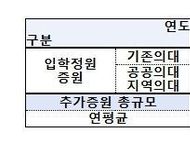
The Ministry of Health and Welfare plans to train an average of 668 doctors annually to work in essential public health services in local areas over the next five years, starting in 2027.
490 in 2027, 613 in 2028 and 2029, and 813 in 2030 and beyond. ▲ Positive scale by year [Republic of Korea Education Newspaper] On February 10th at 2:00 PM, the Ministry of Health and Welfare held the 7th "Health and Medical Policy Deliberation Committee" (hereinafter referred to as the "Review Committee") at the Government Complex Seoul (located in Jongno-gu, Seoul). The committee decided to increase the number of physicians trained by an average of 668 per year from 2027 to 2031 at 32 medical schools, excluding Seoul, to strengthen regional, essential, and public medical services. Any additi
-
17 domestic humanoids gather at DDP, and Seoul City hosts the 'Seoul AI Festival'
Held at DDP from February 28th to March 1st… "Physical AI: Feel It with Your Body" ▲ Seoul AI Festival 2026 Poster [Korea Education Newspaper] Seventeen domestic humanoid robots capable of walking, moving their arms, and understanding human speech will gather at Dongdaemun Design Plaza (DDP). The Seoul Metropolitan Government announced that it will host the "Seoul AI Festival 2026" at DDP Art Hall 1 for two days, from February 28 to March 1. This event, themed “AI spoke to me – Physical AI in everyday life that you can feel with your body,” is a participatory festival designed to allow citizen
-
[SBS My Little Old Boy] Moon Chae-won, to Seo Jang-hoon, who has 4 trillion won(?), says, “Hey, just give me 1 trillion won~” cutely... What will Seo Jang-hoon say?
Moon Chae-won, the icon of first love, returns to SBS's "My Little Old Boy" after five years! "I thought I was a doll," she says, her real-life beauty amazes the studio. ▲ [SBS My Little Old Boy] [Republic of Korea Education Newspaper] On the March 1st broadcast of SBS' 'My Little Old Boy' (hereafter 'My Little Old Boy'), actress Moon Chae-won, the 'icon of first love', will appear as a special MC and is expected to fill the studio with excitement. When Moon Chae-won recently appeared in the recording studio for SBS's "My Little Old Boy," the "Mom Avengers" were in awe, saying, "I thought a do
-
Jeju RISE: Sharing the Results of "Industry-Academic Cooperation"
Jeju Island discussed key achievements and future plans at the 2025 Jeju RISE Project Performance Forum. ▲ 2025 Jeju RISE Achievement Forum Opening Ceremony [Republic of Korea Education Newspaper] Jeju Special Self-Governing Province held the '2025 Jeju RISE Project Achievement Forum' at the Jeju Halla Convention Center on the afternoon of the 26th. This event was designed to share the first year's achievements of the Jeju Regional Innovation Centered University Support System (RISE) project with Jeju residents and to enhance the execution of the cooperative system between the region, universi
-
2026-03-29 08:55
CEO Yoo Jeong-geol – The 'Last Puzzle' of Medical School Admission is Literacy: The Victory of Intellect Overcoming Skill
-
2026-03-22 20:54
"Peace Begins in Life"… IWPG Successfully Concludes 'Only Peace Conference' in Busan
-
2026-03-11 23:52
The Ministry of Health and Welfare plans to train an average of 668 doctors annually to work in essential public health services in local areas over the next five years, starting in 2027.
-
2026-03-11 23:50
17 domestic humanoids gather at DDP, and Seoul City hosts the 'Seoul AI Festival'
-
2026-03-11 23:47
[SBS My Little Old Boy] Moon Chae-won, to Seo Jang-hoon, who has 4 trillion won(?), says, “Hey, just give me 1 trillion won~” cutely... What will Seo Jang-hoon say?


주소 : 서울특별시 강남구 테헤란로83길 18 4층 // 경기도 구리시 건원대로 36 화성골드프라자 902-1-9
등록번호: 경기,아54214 | 등록일 : 2024-10-08 | 발행일자 : 2024-10-08 | 발행인 : 조정인 | 편집인 : 조정인 | 전화번호 : 070-4079-2579 | 이메일 : eduladder@naver.com
Copyright @대한민국영어신문 All rights reserved.

UPDATE: 2026년 03월 29일 08시 55분